Introduction
Why Drying Is Critical in Biomass Briquetting
In the biomass briquetting industry, raw material preparation plays a crucial role. It helps determine the final product quality. One of the most crucial steps is drying. Biomass materials include sawdust, rice husk, and wood chips. They usually contain high moisture levels. They significantly impact briquette density. In addition, they affect the combustion efficiency and durability. Optimal briquetting requires the moisture content to be reduced by around 8 to 12 percent.
Excess moisture leads to poor binding. Also, it is responsible for a lower calorific value and increased smoke emissions during combustion. This is where industrial drying systems play an important role.
Two of the most commonly used drying techniques include the rotary drum dryer and the flash dryer. You need to choose between them. However, the factors include raw material type and moisture level. Consider the production capacity and operational cost.
This article provides a clear comparison of these systems. With that, you can make an informed decision.
What is a rotary drum dryer? How it works and best use cases
A rotary drum dryer is one of the most widely used drying systems in biomass processing. It consists of a large and rotating cylindrical drum. The hot air passes through the drum. Wet raw material is fed into one end of the drum. It gradually moves towards the outlet when the drum rotates.
- How does it work?
The wet biomass enters the drum through a feeding system. Then the drum rotates slowly. It lifts and cascades the material. The hot air flows either co-currently or counter-currently. Moisture evaporates when the material tumbles. The dried material exits from the discharge end. The continuous tumbling ensures uniform drying. In addition, it also prevents material clumping.
- Key features
- It handles large particle sizes.
- It is suitable for high moisture materials up to 50-60%.
- It is robust and has a durable construction.
- It can process high volumes continuously.
- Best use cases
The rotary dryer machine is ideal for wood chips and bagasse. It is best for agricultural waste with uneven particle sizes. It can handle materials with high initial moisture. It has flexibility and durability. This is the reason many large-scale briquetting plants rely on the dryer rotary dryer setup. It guarantees consistent output.
What is a flash dryer, how it works, and the best use cases
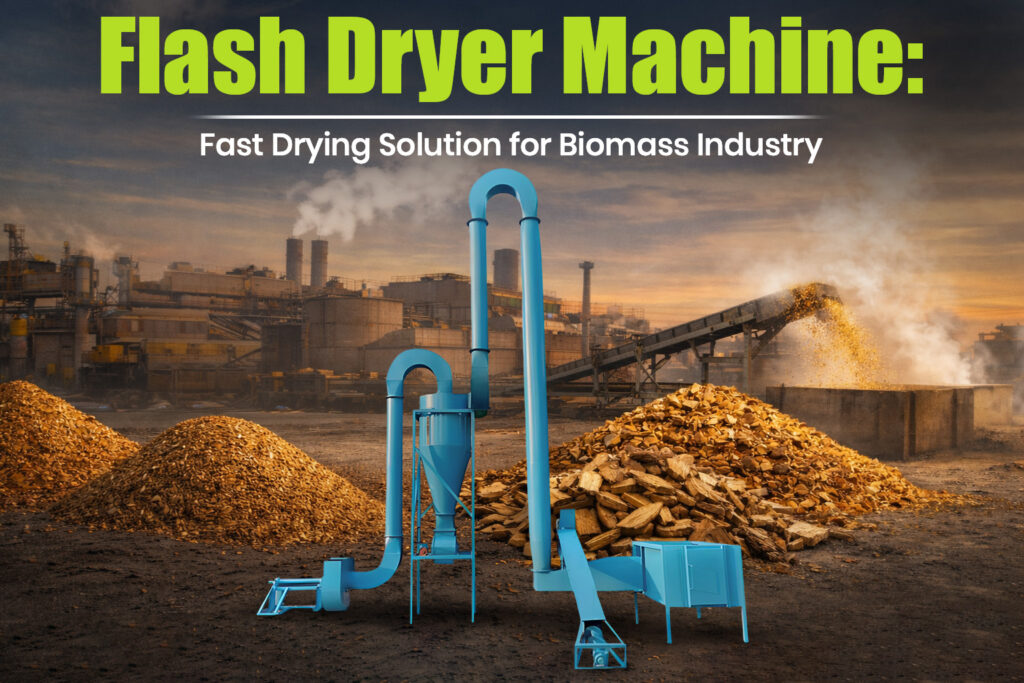
A flash dryer serves as a high-speed drying system. It is designed for fine and lightweight materials. It is different from rotary dryers. It uses a stream of hot air. The system helps rapidly dry the particles while they are suspended in airflow.
- How it works
The wet material is fed into the drying chamber. A high-velocity stream of hot air carries the particles. The moisture evaporates almost instantly. It happens due to the high heat transfer. The cyclone separators collect the dried material. There are fine particles discharged efficiently. The drying process happens in seconds. It is extremely fast.
- Key features
- The drying process is very fast. It has a compact design.
- It is efficient for the uniform and fine materials.
- There is a lower space requirement.
- Best use cases
A flash dryer works best for sawdust and fine powders. It is also best for small, uniform biomass particles. It can work for materials with moderate moisture levels. It is especially useful in plants where space is limited. Also, it is great for rapid processing.
Rotary dryer vs flash dryer: Head-to-Head Comparison
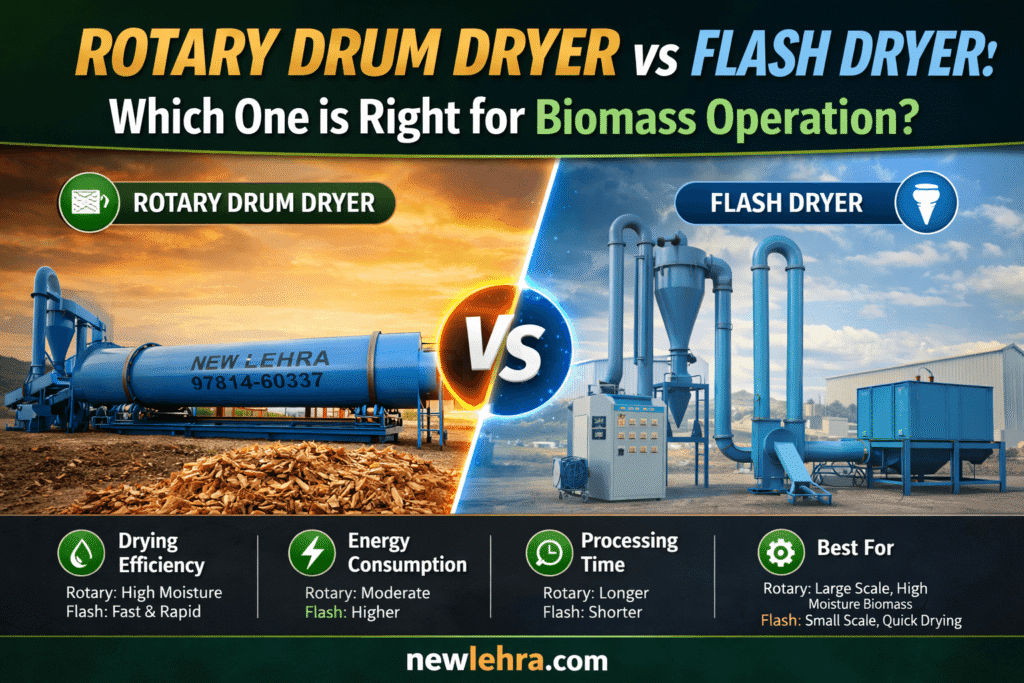
Below is a side-by-side comparison to highlight the major differences between the two systems.
| Feature | Rotary Drum Dryer | Flash Dryer |
| Drying Speed | Moderate | Very fast |
| Material Type | Large, coarse particles | Fine, uniform particles |
| Moisture Handling | High (up to 60%) | Moderate (up to approximately 35%) |
| Capacity | High throughput | Medium to high |
| Fuel Consumption | Higher | More efficient |
| Installation Space | Requires more space | Compact setup |
| Maintenance | Moderate | Lower (fewer moving parts) |
| Initial Cost | Higher | Slightly lower |
| Drying Uniformity | Excellent | Good (depends on particle size) |
When it comes to evaluating rotary dryers versus flash dryers, it becomes clear that each of them serves a distinct purpose. They serve in the form of different systems working better with different materials.
Which dryer suits which raw material?
Selecting the right dryer depends heavily on the type and condition of the biomass material.
- Rice husk
Rice husk is lightweight, and it contains moderate moisture. A flash dryer is highly effective when the husk is already finely processed. When the moisture levels are high or the husk is clumped, a rotary drum dryer performs better.
- Sawdust
Sawdust is one of the most common materials in briquetting. It is already fine and uniform. A flash dryer is usually the best option. It ensures rapid drying in addition to energy efficiency.
- Wood chips
Wood chips are larger and bulkier. They are unsuitable for flash drying. A rotary dryer machine is the ideal choice. It handles large particle sizes. In addition, it can also work favourably for higher moisture content.
- Mixed biomass
When the operation involves mixed or inconsistent raw materials, a rotary drum dryer offers greater flexibility. It processes a wide range of particle sizes. It does not compromise the efficiency.
Common mistakes when choosing a dryer
Selecting the wrong system leads to inefficiencies. Also, it is responsible for higher costs and poor briquette quality. Some of the common mistakes to avoid are as follows.
- Ignoring the moisture levels
Many operators underestimate the importance of initial moisture content. A flash dryer struggles with extremely wet materials. A rotary drum dryer is highly suitable for such conditions.
- Overlooking the particle size
Flash dryers require uniform and fine particles. You should feed small chunks. Large chunks in a flash system create blockages. Also, it is responsible for uneven drying. F
- Focusing only on the initial cost
Flash dryers appear more affordable upfront. However, the long-term suitability and efficiency play the deciding factors. A mismatch results in higher operational costs. Not considering future expansion.
You need to plan to scale the production at a time. A rotary dry machine offers better long-term flexibility. It is due to the higher capacity.
- Poor system integration
Dryers should be compatible with the other components. It should be compatible with feeders, cyclones, and briquetting machines. Improper integration reduces overall plant efficiency.
- Choosing without expert guidance
Drying requirements vary widely depending on the raw material. Also, production goals play a huge role. Consulting experienced manufacturers, such as New Lehra Industries, helps ensure that you select the right system. You don’t have to then deal with costly trial and error.
- Ignoring energy efficiency and fuel type
Another common mistake is overlooking energy consumption. Usually, people don’t pay attention to the fuel compatibility of the drying system. Different dryers operate with varying thermal efficiency. So, choosing the wrong one significantly increases long-term operational costs.
A rotary drum dryer consumes more fuel when handling smaller and low-moisture materials. A flash dryer system proves more energy efficient in such cases. The availability of fuel, like biomass, coal, or gas, is important.
Consider it during the selection. Evaluating the energy efficiency alongside production needs ensures better cost control. It also guarantees sustainable plant operation.
Final thoughts
Both the rotary drum dryer and the flash dryer are essential technologies in biomass processing. However, they serve different operational purposes.
- Choose a rotary drum dryer to handle high moisture. It can also handle coarse or mixed materials. It requires high-capacity output.
- Opt for a flash dryer when the material is fine and uniform. It guarantees rapid and energy-efficient drying.
You need to understand the differences. It helps in optimizing the drying process. The right drying solution in place will let you significantly improve the product quality. It also reduces the energy consumption. It enhances the overall plant performance. Businesses can now scale efficiently by investing in the right drying technology. It will be a great operational decision, which will also be a strategic one.