Global industries have been facing increasing pressure to reduce carbon emissions. There is a high debate surrounding white coal vs black coal. In addition, there are issues like managing fuel cost and complying with environmental regulations. Traditional fossil fuels were once considered the backbone of industrial energy. But cleaner, renewable alternatives are now replacing them.
Among these, biomass briquettes for industries have emerged as a practical solution. They are also commonly referred to as white coal, which is a sustainable solution. The shift is not just due to environmental responsibility. Economic efficiency and energy security are the core drivers as well. In addition, there are aspects like operational reliability.
There has been an advancement in the briquetting technology. With the growing role of the white coal briquette machine manufacturer industries now have access to the consistent and high-quality fuel. Those Fuels meet the modern energy demands.
Understanding White Coal and Black Coal
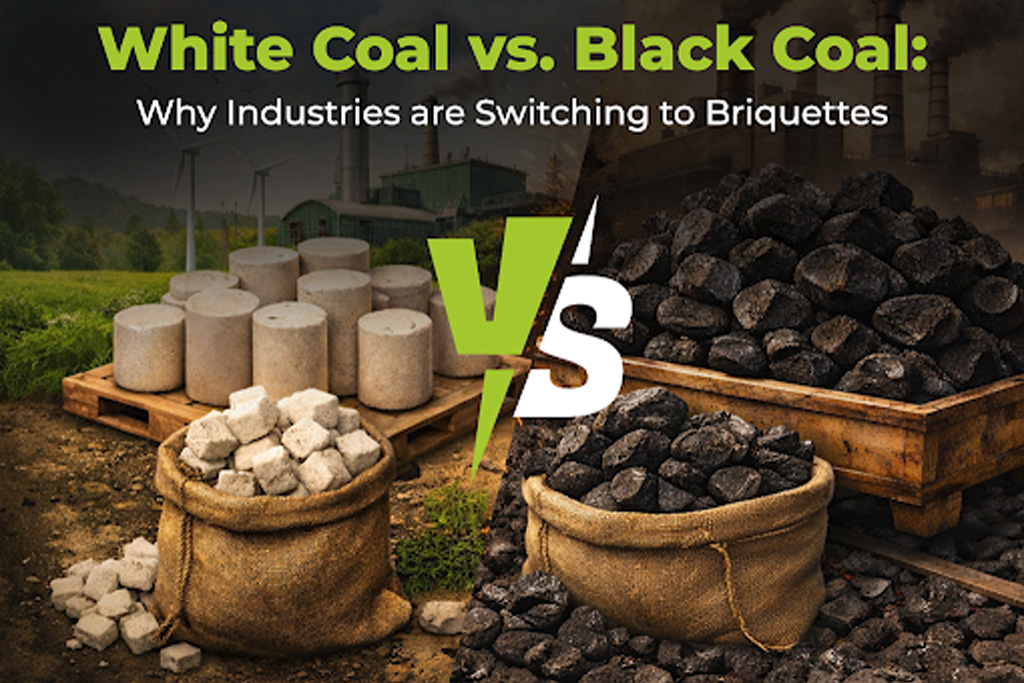
It is important to understand the fundamental difference between the two fuels for understanding how the industries are transitioning. Black coal refers to the fossil coal mined from the Earth over millions of years. It is carbon-intensive, non-renewable, and releases significant amounts of greenhouse gases. Also, it emits sulphur dioxide and particulate matter during combustion.
On the other hand, white coal is a renewable fuel from agricultural waste. The other wastes include forestry residues and biomass materials. The materials are compressed into the briquettes using high pressure. There are no chemical additives, making them an eco-friendly alternative. The comparison of white coal vs black coal highlights a major difference in sustainability, availability, and environmental impact.
Environmental Impact: A Key Reason for the Shift
One of the most compelling reasons industries are adopting white coal is environmental compliance. Governments are tightening emission norms. Besides, industries are reducing their carbon footprint. When comparing white coal vs black coal, it’s worth noting that White coal offers minimal sulphur and ash content. Also, there are significantly lower carbon emissions. Reduced air pollution and smoke generation are other advantages. Biomass for industries is produced from renewable waste materials.
The carbon emissions are nearly carbon neutral. The carbon released during combustion is roughly equal to what the biomass absorbed during growth. So white coal has emerged as a cleaner energy cycle. In contrast black coal combustion releases long-stored carbon into the atmosphere. It accelerates climate change and environmental degradation.
Cost Efficiency and Fuel Economics
Fuel cost is a decisive factor for industrial operations. It is especially true for energy-intensive sectors like cement, textiles, steel, and food processing. Over time, the economics of white coal vs black coal have shifted in favour of biomass briquettes. White coal briquettes often have stable pricing compared to volatile coal markets. They cost less per unit of usable heat and reduce transportation and storage costs due to local sourcing.
Biomass briquettes for industries are produced from agricultural and forestry waste. Global fuel price fluctuations affect them less. Industries located near biomass sources benefit even more by lowering logistics expenses.
Black coal prices fluctuate due to mining regulations. Also, there are other aspects like import duties and global demand. Long-term budgeting becomes difficult.
Energy efficiency and performance
A common misconception is that renewable fuel lacks the efficiency of fossil fuels. The truth is, modern briquettes challenge this assumption. When evaluating white coal vs black coal, high-quality white coal briquettes provide uniform size and density for efficient combustion. Also, it is known for consistent calorie value and lower moisture, and ash content.
These properties ensure stable boiler performance and improved heat transfer. Many industries report even better efficiency after switching to biomass briquettes for industries. There are major advantages, especially when using optimized combustion systems.
Black coal is energy-dense. It often contains impurities that reduce efficiency and increase maintenance
requirements.
Operational benefits for industries
Beyond cost and efficiency, white coal offers several operational advantages. Industries switching from briquettes often experience smoother operations. Also, there is reduced downtime. Operational benefits include Less clinker and slag formation. Besides, there is reduced boiler fouling and corrosion. It ensures lower maintenance and cleaning frequency. Comparison of white coal vs black coal becomes even more compelling for industries looking for long-term operational stability. Cleaner combustion leads to extended equipment life. Also, there are lower maintenance costs.
The Role of Biomass Briquettes in Industrial Sustainability
Sustainability is no longer optional. It has become a strategic necessity. Companies are increasingly evaluated based on their environmental practices. Biomass briquettes for industries are an important part of corporate sustainability strategies. Using white coal helps industries improve brand reputation.
It also meets ESG and sustainability targets. They align with green energy policies and improve bran reputation. Additionally, utilising agricultural-based public support helps the rural economies. It promotes circular resource use. It creates a win-win scenario where industries reduce emissions while contributing to socio-economic development.
Advancement in Briquetting Technology
There has been a growing demand for white coal. It has driven the technological innovation in briquetting machinery. A reliable white coal briquette machine manufacturer plays a crucial role in ensuring consistent fuel quality. Also, it guarantees a large-scale production. Modern briquette machines offer automation for consistent output. It ensures the high compression ratios for dense briquettes.
It guarantees compatibility with the various materials. Advancements are helping the industry source briquettes that meet strict performance standards. A trusted white coal briquette machine manufacturer ensures efficient production and minimal waste. It also guarantees a long-term operational reliability for briquette suppliers.
Government Policies and Regulatory Support
Another factor accelerating the shift in white coal vs black coal is policy support. Many governments offer incentives and subsidies in addition to tax benefits. Therefore, it is easy to adopt renewable energy. Industries using biomass briquettes for industries may benefit from reduced environmental compliance costs. There is also carbon credit eligibility. It ensures easier regulatory approvals. In contrast, black coal usage increasingly faces penalties and higher taxes. Also, there are strict emission controls. Regulatory landscape makes white coal a future-proof energy choice.
Industry Adoption Across Sectors
The transition to white coal is not limited to a single sector. Industries across Multiple domains are making the switch.
It includes:
- Cement and brick manufacturing
- Textile processing units
- Food and agro-processing plants
- Chemical and pharmaceutical industries
The comparison of white coal vs black coal consistently favours briquettes due to flexibility. Also, there are advantages like sustainability and cost savings.
Briquetting Machines and End-to-End Biomass Solutions
Industries have been shifting from fossil fuels to white coal. For making this shift possible, they require more than just an alternative fuel. They need reliable briquetting machines and complete biomass solutions. Such considerations ensure consistent quality and supply. Efficient biomass briquette production depends on the ability to process diverse agro-waste materials into uniform, high-density fuel. The fuel then becomes suitable for industrial boilers. Integrated biomass solutions become essential in such situations.
Modern briquetting systems combine drying, grinding, and briquetting technologies. The end objective is to handle variations in moisture content and particle size common in agricultural waste. Advanced briquetting machines deliver a stable calorific value and low ash content. The added advantage in this regard is the consistent briquette shape. All of these are necessary for directly improving combustion efficiency and reducing operational issues.
There’s a need for access to reliable biomass-processing machinery across several modern industries. Having access to this equipment ensures a smooth transition to renewable fuel. End-to-end biomass solutions help industries achieve long-term fuel security. Also, there are added advantages in terms of regulatory compliance and sustainable energy performance without compromising productivity.
Future of Industrial Fuel: A Clear Direction
There is a debate around white coal vs black coal. That is no longer theoretical. Factory floors worldwide have been involved. Industries prioritize sustainability, cost control. Also, there is regulatory compliance. White coal briquettes are emerging as the preferred alternative.
Innovation has been driving the continued growth of biomass briquettes for industries. Every white coal briquette machine manufacturer has been driving innovation as well. It signals a clear shift toward cleaner industrial energy. White coal is not just an alternative fuel. It serves as a strategic investment in a sustainable industrial future.