
In modern industrial processing efficient drying systems play a critical role. It ensures product quality and energy efficiency. Also, it offers operational consistency. From minerals and chemicals to biomass and agro- waste, industries rely on advanced drying technologies. These technologies help reduce moisture content before further processing. The most common used systems are the Rotary drum dryer and the flash dryer.
Understanding how these systems work and knowing when to choose one over the other is essential. Both manufacturers and plant operators should look into these considerations. The article explains what a Rotary drum dryer is, and how. It works. Also, discover why many industries prefer it when comparing Rotary drum dryer vs flash dryer solutions.
What Is a Rotary Drum Dryer?
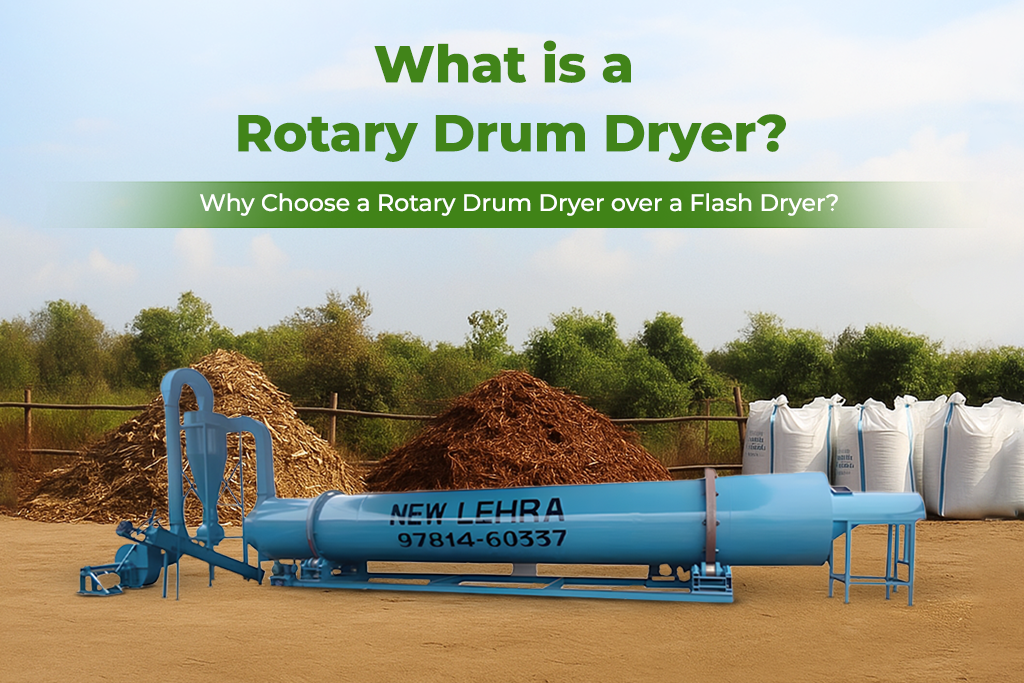
A Rotary drum dryer is an industrial drying system designed to remove moisture from bulk solids through continuous tumbling. Also, there is involvement of heat transfer. It consists of a large and rotating cylindrical drum mounted at a slight incline. Wet material is fed from one end. As the drum keeps rotating, the material is lifted and cascaded through a stream of hot air. The constant motion ensures uniform exposure to heat.
It results in consistent drying across a wide range of particle sizes and moisture levels. A reliable rotary drum dryer manufacturer designs the systems. The systems handle throughput while maintaining energy efficiency and durability. These systems are highly suitable for heavy-duty Industrial operations.
How does a rotary drum Dryer work?
The operation of a Rotary drum dryer follows a straightforward, yet highly effective process. The first step involves wet material entering the rotary. The second step is internal lifting flights raise and shower the material through hot gas. The third step is the heat transfer from the gas to the material and evaporating moisture. The fourth step involves the dried material exiting from the discharge end.
Depending on the application requirements, the system can operate in the co-current or counter-current airflow configurations. The flexibility always allows the industries to control temperature exposure. Thus, rotary dryers become suitable for heat-sensitive as well as robust materials.
Common Applications of Rotary Drum Dryers
Due to their versatility, Rotary drum dryer systems are widely used across multiple industries. The industries that use them include Biomass and agro-waste processing, food and agricultural by-products, minerals, and ores. Also, there are chemicals and fertilisers in addition to Sand, clay, and aggregates-based industry. A reputable Rotary drum dryer manufacturer customizes drum size and air flow, as well. There is a customized rotation speed, airflow, and material handling features. These aspects are necessary for matching the specific process needs.
What Is a Flash Dryer?
A flash dryer is a high-speed drying system designed for fine, uniform particles with low initial moisture content. It works by disrupting wet material into a hot air stream. The moisture evaporates almost instantly due to the high heat and velocity. Flash dryers are compact and fast, but require strict control over feed consistency. The limitation becomes a key factor when evaluating Rotary drum dryer vs flash dryer options.
Rotary Drum Dryer vs Flash Dryer: Core Differences
Comparing the Rotary drum dryer vs flash dryer, it can be said that the choice completely depends on the material properties and the production scale. In addition to the operation of flexibility.
Material Compatibility
Regarding the material compatibility, note the point that a rotary drum dryer can handle irregular shapes and
large particle sizes. Also, it is fit for the high moisture content and sticky or fibrous material the other hand, the
flash dryers perform best with lower to moderate moisture content, Fine, uniform particles, as well as free-
flowing materials. All these aspects make rotary dryers far more adaptable to real-world industrial feedstock
variations.
- Moisture Reduction Capability
Regarding the moisture reduction capability, one major advantage of the Rotary drum dryer vs flash dryer comparison is the moisture-handling capacity. Rotary drum dryers allow gradual and controlled drying. In addition, it also handles the high initial moisture levels and reduces the risk of overheating.
Flash dryers require pre-dewatered material. In addition, they often struggle with wet or sticky feed.
Rotary dryers put an end to the issue – they are more reliable for industries dealing with biomass, sludge, or agro-waste.
- Throughput and Scalability
A Rotary drum dryer is ideal for high-capacity, continuous operations. It processes large volumes consistently without compromising drying quality.
On the contrary, the flash dryers are better suited for the small to medium scale applications. The problem with these systems is that they are limited in capacity.
A leading Rotary drum dryer manufacturer can scale systems for expanding production demands. Also, one of the prime reasons to invest in rotary dryers is that they are durable in the long run.
- Energy Efficiency and Heat Utilization
Flash dryers achieve rapid drying, but they often require higher energy input due to high air velocities and temperatures. In contrast, Rotary drum dryer systems allow heat recovery integration. Also, they use moderate temperatures and offer better energy balance for bulk materials. Efficiency advantage strengthens the case in the Rotary drum dryer vs flash dryer decision for energy-intensive industries.
- Product Quality and Uniformity
Regarding the product quality and uniformity, product quality is a critical factor in industrial drying. Rotary drum dryers provide minimal product degradation and uniform moisture reduction. In addition, it also ensures gentle handling for fragile materials. The Flash dryers may cause Inconsistent drying if the feed varies. Also, there might be chances of particle degradation.
For industries prioritising consistent output quality, it is recommended to use the rotary drum dryer as the preferred solution.
Maintenance and Operational Simplicity
Key consideration in the Rotary drum dryer vs flash dryer debate is maintenance. Rotary drum dryers are easier to inspect and repair. Also, they have simple mechanical designs. They can handle contamination and feed variation well.
Flash dryers, on the other hand, are sensitive to blockages and feed changes. Also, they require precise air flow control.
A dependable Rotary drum dryer manufacturer ensures long service life with minimal downtime. It stays true, especially in demanding industrial environments.
Why Industries Choose Rotary Drum Dryers?
Industries increasingly favor rotary dryers because they offer wide material compatibility. Also, there are other advantages like high operational flexibility and a lower risk of this process failure. The long-term cost efficiency is an added advantage.
In many cases, the flash dryer appears compact and fast. However broader advantages of a Rotary drum dryer
outweigh the initial footprint benefits.
Role of a Reliable Rotary Drum Dryer Manufacturer
Choosing the right Rotary drum dryer manufacturer is an important consideration, as is selecting the technology itself. A quality manufacturer provides robust material construction. In addition, it guarantees the application-specific design. Energy-optimized systems, after-sales support, and customization are some noteworthy aspects.
An experienced Rotary drum dryer manufacturer ensures that the dryer integrates seamlessly with upstream and downstream processes. It ensures maximizing overall plant efficiency.
Expertise in Biomass and Agro-Waste Drying Solutions
modern rotary drum dryers to efficiently handle high-moisture, variable feedstock. The reason behind the same is extensive experience in biomass and agro-waste drying. These dryers seamlessly integrate with grinders, conveyors, and briquetting systems to form end-to-end biomass solutions. All of this ensures consistent fuel quality, optimized energy use, and reliable large-scale biomass processing operations.
Final Verdict: Which Dryer Is Right for You?
When comparing Rotary drum dryer vs flash dryer, there is no one-size-fits-all answer. The Rotary drum dryer stands out as the most reliable and versatile choice for industries handling variable feedstock. Also, it is the best choice for industries dealing with high moisture content or large production volumes. Proven performance across multiple sectors and support from a trusted Rotary drum dryer manufacturer allow rotary dryers to continue to be the backbone of industrial drying operations worldwide.