Industries and energy producers increasingly adopt renewable fuel solutions. In this regard, biomass briquette
production has emerged as a reliable and sustainable alternative to fossil fuels. Briquetting has the ability to
convert widely available agricultural residues into high-value solid fuel. This has proved to be one of the
biggest advantages of briquetting. However, it’s worth noting that selecting the right briquetting raw materials
plays a crucial role in determining briquette quality. Also, it is significant in calorific value and overall
production efficiency. There has been a growing use of agro waste for biomass briquettes machine systems.
These industries can maximize local resources. Also, it helps reduce waste disposal issues and creates a circular
energy economy.
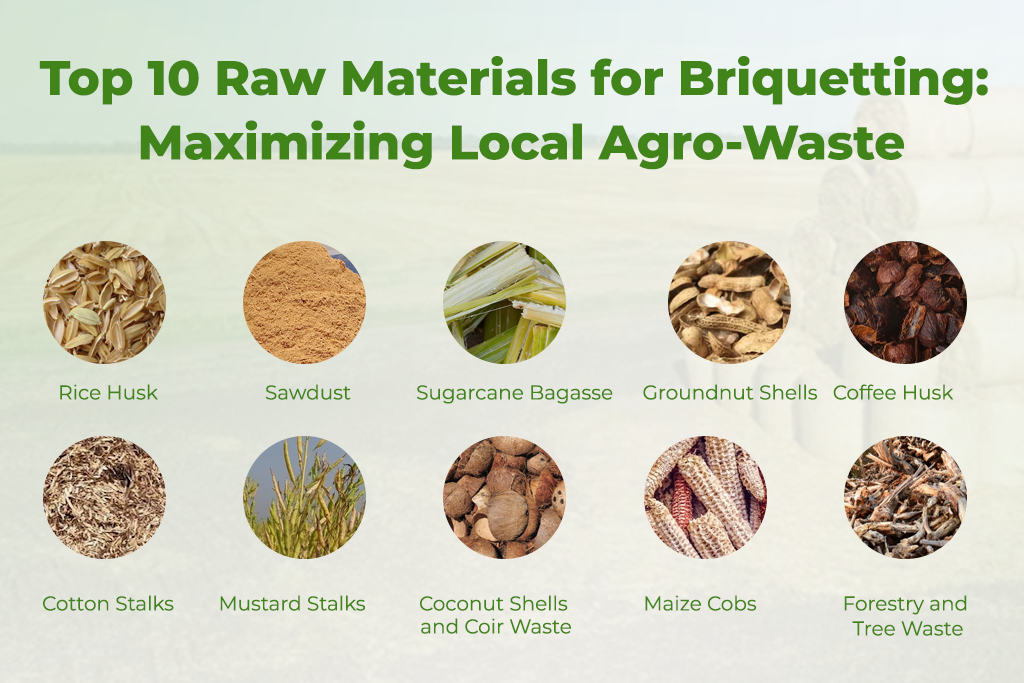
This article explores the top 10 raw materials for briquetting. Also, learn how they support efficient and
scalable biomass energy production.
Understanding Briquetting Raw Materials
Briquetting raw materials refers to organic waste materials that are compressed under high pressure. They can
form solid fuel briquettes. These materials are rich in lignin. It acts as a natural binder during compression.
Also, lignin ensures the eliminating of the need for chemical additives.
The availability of local agro waste is a major driver of cost-effective biomass briquette production. That being
said, briquetting has emerged as an ideal solution for agricultural regions and biomass-rich industrial zones.
Importance of Agro Waste in Biomass Briquette Production
Agricultural waste is often underutilized or burned in open fields. In this regard, Agricultural waste contributes
to air pollution and environmental damage. Using agro waste for biomass briquettes machine operations lets
industries transform these residues into clean-burning fuel.
Key benefits include Lower fuel costs and reduced waste disposal challenges. Additionally, there are benefits
such as sustainable energy generation and Additional income for farmers. Now, let’s explore the top raw
materials used in briquetting.
-
- Rice Husk
Rice husk is one of the most widely used raw materials for briquetting. It is especially popular in rice-producing
regions. Rice husk is lightweight, abundant, and has a moderate calorific value. Advantages include High availability, suitability for continuous biomass briquette production. Also, it has a Low
cost. Rice husk briquettes are commonly used in boilers, furnaces, and thermal plants.
- Rice Husk
-
- Sawdust
Sawdust is a highly efficient raw material. It is popular for its fine particle size and high lignin content. Sawdust
is ideal for producing dense and durable briquettes.
Benefits include High calorific value, Excellent binding properties. Alo, it guarantees Consistent quality output.
Sawdust is a highly preferred agro-waste feedstock for biomass briquette machine setups. The reason is the
minimal preprocessing requirements.
- Sawdust
-
- Sugarcane Bagasse
Bagasse is the fibrous residue left after sugarcane crushing. It is a cornerstone of biomass briquette
production, making it a popular option in sugar-producing regions.
Why bagasse works well is its high fiber content and abundant seasonal availability. Also, there are benefits
such as good combustion efficiency. Sugar mills and cogeneration plants largely depend on Bagasse briquettes.
- Sugarcane Bagasse
-
- Groundnut Shells
Groundnut shells are an excellent agro-based fuel. What makes it impeccable is its good calorific value and low
ash content.
Key advantages include that Groundnut shells are Easy to grind and compress, and have low moisture content.
- Groundnut Shells
Groundnut shells are Suitable for small and large-scale briquetting. They are increasingly used as briquetting
raw materials in rural and semi-industrial energy systems.
-
- Coffee Husk
Coffee husk is an emerging raw material in regions with significant coffee production. It produces high-quality
briquettes when processed correctly.
Benefits include High heat output and Efficient use in biomass briquette production. Also, it guarantees
reduced waste accumulation.
Coffee husk briquettes are common in food processing and small industrial boilers.
- Coffee Husk
-
- Cotton Stalks
Cotton farming generates large quantities of stalk waste after harvesting. Agro waste for biomass briquettes
machine technology be shred and process these stalks.
Advantages include good burning characteristics, High availability in cotton-growing regions. It guarantees
Cost-effective raw material sourcing. Cotton stalk briquettes help reduce field burning and promote
sustainable energy use.
- Cotton Stalks
-
- Mustard Stalks
Mustard stalks are a popular choice among briquetting raw materials. It finds wide use, especially in northern
agricultural regions.
Why they are effective is that Mustard stalks are easy to collect post-harvest. There are additional benefits like
it as Moderate calorific value, Suitable for industrial and domestic fuel use.
Mustard stalks support decentralized biomass briquette production in farming communities.
- Mustard Stalks
-
- Coconut Shells and Coir Waste
Coconut shells and coir waste are highly valued due to their high density and energy output.
Key benefits include that Coconut shells and coir waste have Low moisture content and High calorific value.
Also, they are fit in terms of long burning time.
Coconut shells and coir waste perform exceptionally well in agro waste for biomass briquettes machine
systems. These materials are often used for export-grade briquettes.
- Coconut Shells and Coir Waste
-
- Maize Cobs
Maize cobs are widely available in corn-producing regions and are easy to process.
Advantages include the fact that Maize cobs are Uniform in size after crushing and have Stable combustion
performance. Also, they are known for Low ash generation.
Maize cobs are frequently used in medium-scale biomass briquette production plants.
- Maize Cobs
-
- Forestry and Tree Waste
Wood chips, bark, and pruning residues from forestry operations serve as reliable briquetting raw materials.
Forestry and Tree Waste are known for their high lignin content and compatibility with industrial boilers. Also,
they are impressive in terms of Consistent fuel quality.
Forestry waste is especially suitable for large-scale briquetting operations.
Choosing the Right Raw Material Mix
Successful biomass briquette production often involves blending multiple raw materials. These materials help
achieve optimal density, calorific value. Also, there is scanty ash content. Factors to consider when choosing
the Right Raw Material Mix include Local availability, Moisture levels.
- Forestry and Tree Waste
Other considerations include processing requirements and end-use applications.
A well-designed agro-waste-to-biomass briquette machine setup is immensely helpful. The reason is the
flexibility in selecting and blending raw materials.
Economic and Environmental Impact
Using local agro waste as briquetting raw materials reduces dependency on fossil fuels and imported coal. It
also minimizes transportation costs and supports local supply chains.
Environmental benefits include the Prevention of open-field burning and reduced greenhouse gas emissions.
Also, there is improved waste management.
These advantages make briquetting an attractive investment for industries and rural entrepreneurs alike.
Integrated Drying, Grinding, and Material Handling for Efficient Briquetting
Efficient biomass briquette production depends on the quality of the raw materials. Also, seamless integration
with supporting machinery plays a major role.
Agro waste often contains high moisture and irregular particle sizes. These aspects affect briquette density and
calorific value.
In this regard, it can be suggested that industrial dryers, such as rotary drum dryers or flash dryers, play a vital
role by reducing moisture to optimal levels for consistent briquetting.
Similarly, grinders and size-reduction equipment like hammer mills, chipper grinders, and log shredders ensure
uniform particle size. They can help with improving compaction and combustion efficiency. Proper grinding
also minimizes machine wear and enhances output stability.
Equally important are material handling systems. screw conveyors, belt conveyors, and vibratory feeders
enable smooth, continuous movement of raw materials. Thus, there are no issues between drying, grinding,
and briquetting stages. All of this is impeccable at reducing manual handling and production downtime.
Dryers, grinders, and material-handling systems, when correctly integrated with briquetting machines, help
industries achieve higher productivity. Also, it guarantees consistent fuel quality, lower energy losses. These
aspects help long-term operational reliability in agro-waste to biomass fuel plants.
Conclusion: Turning Waste into an Energy Opportunity
The future of renewable energy lies in efficient resource utilization. Identifying and maximizing the availability
of locally sourced briquetting raw materials helps industries unlock the full potential of biomass briquette
production.
The right agro waste for the biomass briquettes machine ensures that agricultural residues are no longer
waste. They become valuable fuel assets. Energy demands rise, and sustainability becomes a priority. In this
regard, it’s worth noting that briquetting stands out as a practical, scalable solution. Also, it is environmentally
responsible.